
BREATH-HOLDING & BALANCE · AT YOUR PACE
Explore your breath. Find your calm.
ABYSS offers guided dry static breath-hold programmes and natural breathing breaks without breath-holding, shaped around your intention and how you feel.

ONE EXPERIENCE, TWO PATHS
More ease with your breath. More space for calm.
Whether you are discovering breath-holding or looking for a moment to yourself, ABYSS starts with your intention and how you feel.
Develop my breath-holding
Guided, progressive dry static breath-hold sessions. Build your reference points without chasing records.
Find your calm
Natural breathing breaks, without breath-holding. A few minutes to slow down and make time for yourself.
THE ABYSS METHOD
Your journey begins with one breath.
A structured progression that respects your pace, how you feel and your need for recovery.
01
Choose your intention
Progress, calm or both: ABYSS starts with you.
02
Practise at your pace
Guided sessions, difficulty adjusted to your feedback and time for rest.
03
See how things change
A comfortable reference, your own feelings and a personal Journal.
YOUR PERSONAL SPACE
More than seconds.
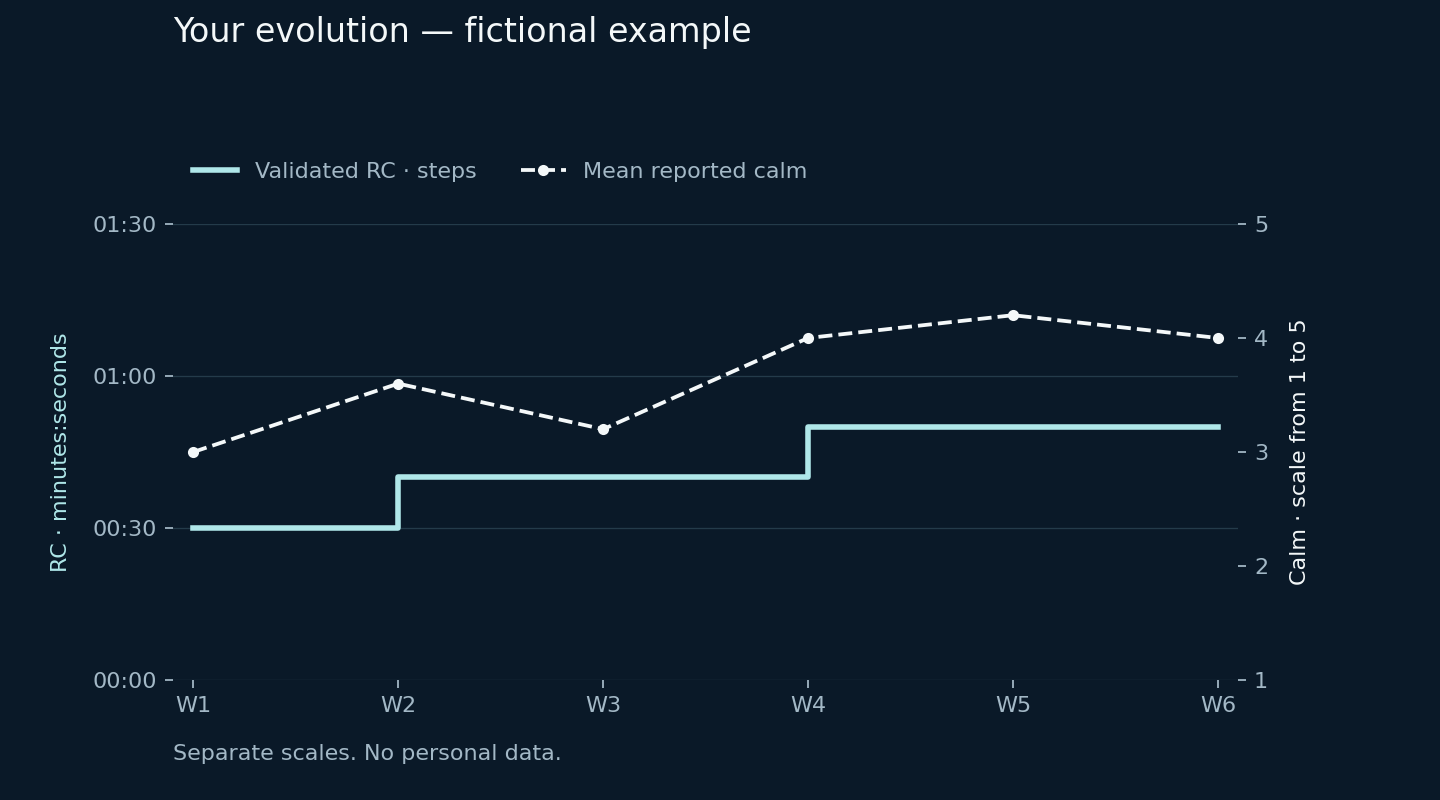
Your programme, sessions and feelings in one personal space. The Journal keeps your validated comfortable reference separate from the calm you report after a session. The illustration below uses fictional data only.
Your programme
Choose a 4, 6, 8, 10 or 12-week programme and a schedule of 2, 3 or 4 sessions a week.
Your evolution
RC in seconds, shown as steps after validation. Self-reported calm on a fixed scale from 1 to 5. These two reference points cannot be compared directly.
Reading the fictional example, weeks 1 to 6: validated RC 00:30, 00:40, 00:40, 00:50, 00:50, 00:50. Mean reported calm: 3, 3.6, 3.2, 4, 4.2, 4 out of 5. The two scales are independent. These values are neither targets nor personal data.
UNDERSTAND & EXPLORE
A different way to notice your breath.
Resources to understand the practice, its limits and progression. Sample articles remain drafts until they have been reviewed.
What is dry static breath-holding?
Understand dry breath-holding and the conditions for practice.
Why take time to progress?
Comfort, steps and recovery: the foundations of the method.
Breathing and relaxation: distinct approaches
Take a break without breath-holding and stay attentive to how you feel.
SAFETY FIRST
Progress begins with listening.
Breath-hold exercises are for dry practice only, seated or lying down in a safe setting. Never practise in water, while driving or in a dangerous situation. Do not hyperventilate. Stop immediately if you feel anything unusual.
A LITTLE MORE EASE, DAY BY DAY
Your breath. Your pace. Your programme.
A personal experience, a few minutes at a time.
Discover your ABYSS space at your pace.